World Naming News Digest: 5 Stories That Shaped the Conversation in March–April 2026
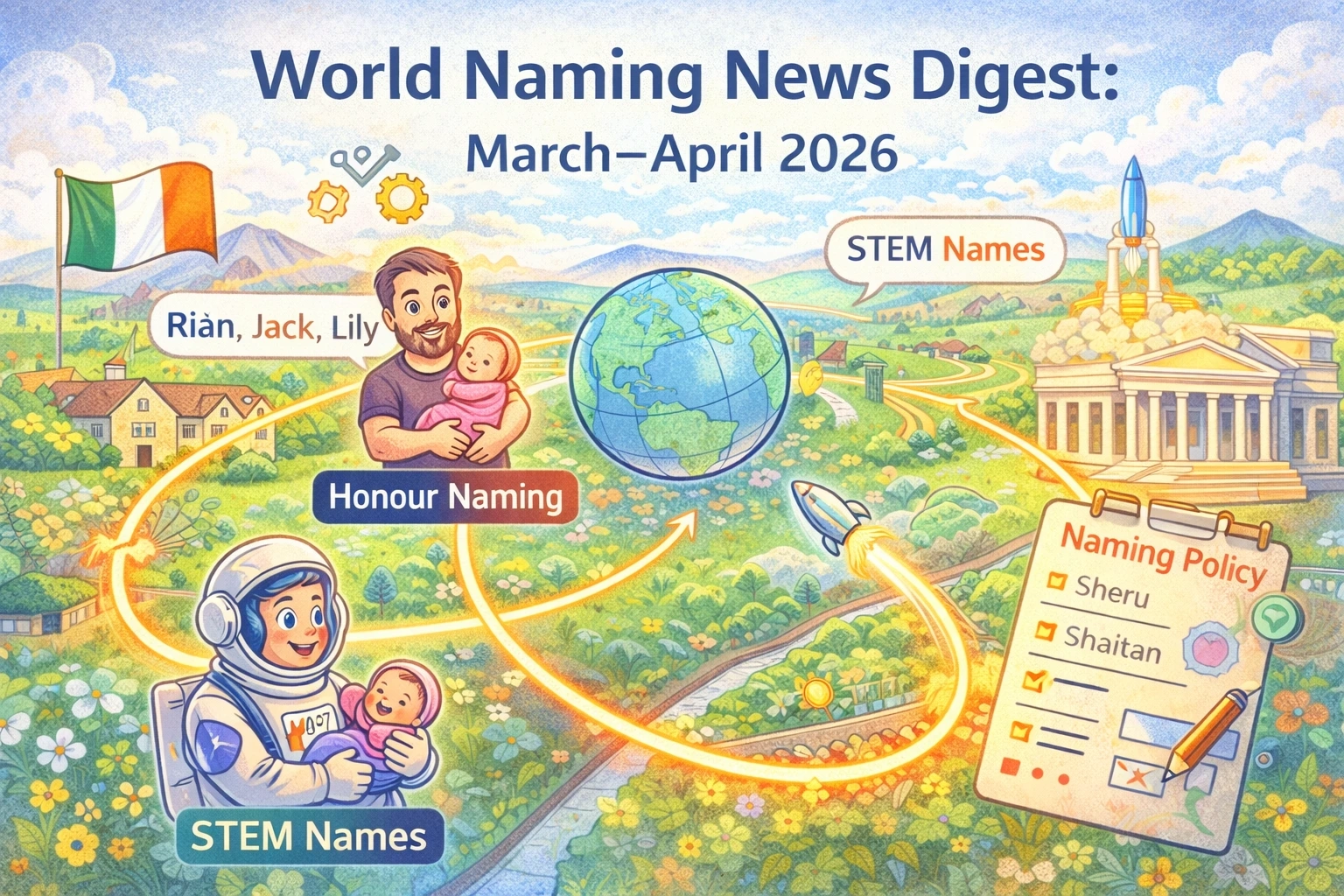
March and April 2026 did not produce one single giant baby-name story.What they produced instead was something more interesting: five very different naming stories that, together, showed where the global conversation is moving.
Across official data releases, celebrity birth announcements and policy debates, names kept returning to the same themes:
- identity
- meaning
- memory
- social usability
- public interpretation
That matters because naming culture is no longer just about what sounds nice. Increasingly, names are being discussed as signals — of heritage, aspiration, dignity, belonging and even worldview.
Here are the five stories that shaped the naming conversation in March–April 2026.
1) Ireland’s latest official data showed a familiar pattern with a modern twist
The strongest data point of the period came from Ireland, where the Central Statistics Office released its 2025 baby-name results at the end of February, setting the tone for the weeks that followed.
For boys, Rían took the top spot, ahead of Jack, Noah, James and Oisín. For girls, Lily led the list, followed by Éabha, Fiadh, Grace and Sadie. Some of the most notable risers included Naoise and Raya, while new or returning names in the Top 100 included forms such as Levi, Elijah, Conall, Mabel, Arabella, Nancy and Ríadh. ()
What made this release especially interesting was not just who ranked first. It was the broader pattern underneath the list. Irish naming continues to show a strong appetite for heritage-rich local forms, while also leaving room for names that travel easily across English-speaking culture. In other words, tradition is not disappearing — it is coexisting with international readability. That combination is increasingly common in naming data across developed, multilingual societies.
For anyone watching naming culture globally, Ireland’s 2025 results reinforced an important point: parents are not simply choosing between “traditional” and “modern” anymore. More often, they want both.
2) Northern Ireland became a “watch this space” story rather than a finished story
April also brought an important naming moment from Northern Ireland — not because the data had already landed, but because the next official release was clearly on the calendar.
The Northern Ireland Statistics and Research Agency listed Baby Names (Northern Ireland) 2025 as a confirmed release scheduled for 16 April 2026 at 9:30am. That made Northern Ireland one of the key naming datasets to watch in the second half of April.
Why does this matter in a digest like this? Because official naming culture is not shaped only by results. It is also shaped by the release cycle itself. Once annual baby-name bulletins become anticipated events, naming starts behaving like a public conversation category — not just a private registry outcome. Governments publish the data, media frames the headlines, and parents read those lists as cultural signals.
That is part of the reason naming stories now travel so widely. A name chart is no longer just statistics. It is trend reporting, identity reporting and lifestyle reporting at the same time.
3) Jack Osbourne’s baby announcement showed how powerful honour names still are
One of the most widely discussed celebrity naming stories of March came from Jack Osbourne, who announced the birth of his daughter Ozzy Matilda Osbourne. The name was widely reported as a tribute to his late father, Ozzy Osbourne.
On the surface, this was a celebrity baby-name story. But culturally, it pointed to something deeper: honour naming remains one of the most emotionally durable naming patterns in modern culture.
What has changed is the style. Older honour names were often subtle — a grandparent’s middle name, a softened variation, a quiet family reference. This case was more direct, more visible and more public. That tells us something about naming in 2026: for many families, especially in public-facing culture, names are increasingly being used not just to remember someone privately, but to make that remembrance legible to everyone else as well.
In other words, memorial naming is not fading. It is becoming more explicit.
4) A space-themed baby name suggested that STEM-inspired naming is getting smarter
In early April, research astronaut Kellie Gerardi announced the birth of her daughter Maxine Quinn, with the nickname Max Q — a reference to the aerospace term “maximum dynamic pressure.” Coverage also noted that her older daughter’s name carries another space-related reference: Delta Victoria, echoing “Delta V.”
This mattered because it showed a more advanced form of science-inspired naming than the broader public usually notices. We have already seen years of names inspired by stars, moons and planets. But this story sat in a narrower and more technical register. It suggested that STEM-coded naming is evolving from broad aesthetic inspiration into specialist symbolic language.
That makes this story useful well beyond celebrity coverage. It shows how names increasingly function as markers of intellectual identity, not just style. A generation ago, science-inspired naming might have meant choosing something futuristic-sounding. In 2026, it can also mean embedding a term that only a more informed audience will immediately recognise.
That is a different kind of naming signal — narrower, sharper and more self-aware.
5) Rajasthan’s naming campaign turned names into a policy issue
The most substantial hard-news naming story of April came from Rajasthan, where the state government launched Sarthak Naam Abhiyan, a campaign aimed at replacing student names considered derogatory, awkward or potentially harmful with more meaningful alternatives, in consultation with parents. Reports said officials were preparing large lists of alternative names and explicitly framed the move around dignity, ridicule and self-esteem.
This was significant because it pushed naming out of lifestyle coverage and into the realm of institutional intervention. Once governments begin treating names as something that can affect educational experience, confidence or social inclusion, the cultural meaning of naming changes. The debate is no longer only about taste. It becomes a debate about power, status, respectability and who gets to define a “good” name.
Whether readers agree with the policy or not, the story matters because it shows how names can be treated as social infrastructure. They are not just labels. They can shape how a child is received in institutions, and that makes them politically legible.
What these five stories reveal about naming right now
Taken together, these stories point to a very clear conclusion:
Naming culture in 2026 is becoming more layered, not less.
At the same time, we are seeing:
- stronger attachment to heritage,
- more explicit memorial naming,
- more niche symbolic references,
- and more public debate about what names do in society.
That means names are operating on several levels at once. A name can be:
- personal,
- emotional,
- cultural,
- strategic,
- and publicly interpreted.
This is why baby-name reporting has become such a durable media category. It is not really about lists alone. It is about what those lists and stories reveal about families, institutions and the values people want names to carry.
Final thought
If March–April 2026 proved anything, it is this:
Names still matter because they do more than identify. They communicate.
Sometimes they communicate heritage.Sometimes memory.Sometimes aspiration.Sometimes social friction.And sometimes all of those things at once.
That is exactly why naming news continues to travel so well across borders. It may look like a soft topic, but underneath it sits one of the hardest questions in culture:
What do people want a name to do now?