Will My Child Share Their Name at School? A Simple Guide to Name Collision Risk in Australia
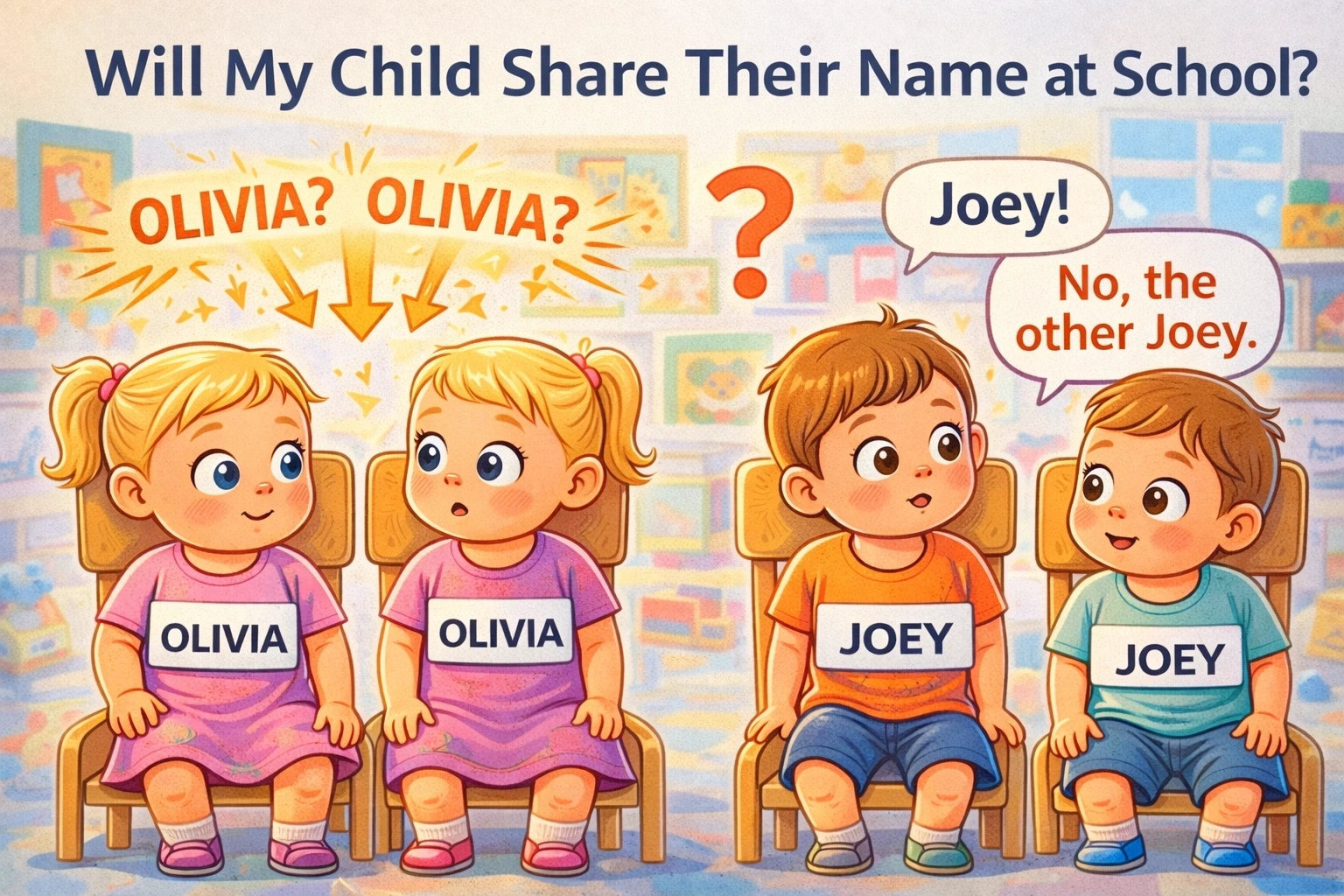
Most parents do not mind if a name is liked by other people.
What they mind is something more specific:
repetition in real life.
Not “popular” in the abstract. Not “Top 100” on a chart.
But the moment when a parent calls one child at daycare and three heads turn.
That is what this article is about.
If you are trying to avoid a name that feels too common, the real question is not:
“What rank is this name?”
It is:
“How likely is my child to share this name in the places where they will actually grow up?”
That is name collision risk.
This guide explains what collision risk really means, why rankings alone do not answer it, and how Australian parents can think about it more clearly.
1) What parents actually fear is not popularity — it is duplication
When people say:
- “We want something not too popular,”
- “We don’t want three in the same class,”
- “We want a name that still feels ours,”
they are usually describing the same concern:
the chance of repeated everyday use in a child’s real environment.
A name can be well liked and still feel manageable.A name can even be Top 100 and not feel overwhelming.
But once duplication becomes normal in daycare, school, sport or family circles, the emotional experience changes. The name starts to feel less personal and more crowded.
That is why collision risk is a more useful concept than raw popularity.
2) What “name collision risk” means in real life
Name collision risk is the likelihood that your child will regularly share their everyday name with other children around them.
That can happen in several places:
- daycare rooms,
- kindy and prep,
- primary school classes,
- birthday parties,
- sport teams,
- family friendship circles.
And importantly, the collision is usually spoken, not just written.
Parents do not usually care whether two children have slightly different spellings on paper.They care whether the room still sounds like:
“Olivia? No, the other Olivia.”
“Theo S. — not Theo M.”
“Which Mia?”
That is what makes collision risk feel real.
3) Why rank does not tell you enough
A ranking chart is useful, but limited.
It tells you position. It does not tell you how likely a name is to feel crowded in daily life.
Why rank is incomplete
A name at #18 and a name at #27 may feel different on paper, but in real usage the gap can be tiny.
A name outside the Top 100 may still collide often if:
- it belongs to a very common sound family,
- it shares a default nickname with many other names,
- it is especially common in your state, city or community.
And the opposite is also true:some names rank highly but are concentrated in a way that feels less repetitive than parents expect.
So rank is not useless — it is just not the final answer.
4) Counts matter more than headlines
If you want a more realistic view, start with counts, not rank.
Ask:
- How many babies actually received this name?
- Is the count far above nearby names, or tightly grouped?
- Does the name sit inside a crowded cluster?
Counts give you a better feel for the size of the name in the real world.
Then go one step further:look at share — the percentage of births that name represents in the dataset you are using.
That moves you closer to the question parents really care about:
How common is this likely to feel around other children?
5) Spoken duplication is often more important than written duplication
This is where many parents get surprised.
A name can look distinct in writing and still feel very common in speech.
That usually happens in two ways:
A) Spelling variants
Different spellings, same everyday sound.
B) Nickname convergence
Different legal names collapse into the same short form.
So even if your chosen spelling or formal version looks less common, the child may still share the same spoken name with others.
That is why collision risk should be judged at three levels:
- exact spelling
- sound family
- likely nickname
If all three point toward crowding, the collision risk is high.
6) Local context matters more than national headlines
Australia is not one naming pool.
A name can behave differently depending on:
- state,
- region,
- suburb,
- school culture,
- linguistic community,
- family network.
A name that feels only moderately popular nationally may feel absolutely everywhere in one local area.
And sometimes a name that looks high nationally does not feel overwhelming in a particular circle.
This is why “national Top 100” should be treated as a starting point, not a verdict.
Your child will not grow up in all of Australia at once.They will grow up inside a much smaller social world.
That smaller world is where collisions happen.
7) A simple way to think about collision risk
You do not need a perfect formula. You need a practical filter.
Low collision risk
The name is uncommon in count, does not belong to a crowded sound family, and does not collapse into a very common nickname.
Moderate collision risk
The exact name is not dominant, but the sound family or nickname is active enough that occasional duplication is likely.
High collision risk
The exact name, its variants, or its nickname are all common enough that repeated encounters are normal.
This kind of framework is more useful than obsessing over whether a name sits at #41 or #63.
8) The “daycare test”
Before you commit to a name, imagine it in a real room.
Ask yourself:
- What will educators and other parents actually say aloud? The full form, or the short form?
- If another child has a similar spelling or full name, will it still sound identical?
- Would I be surprised to hear this name called twice in the same room? If the honest answer is no, your collision risk is already moderate or high.
- Am I comfortable with that? Some parents are. Some are not.
This is the important part: high collision risk is not automatically bad.It is only bad if it clashes with what you want.
9) How to reduce collision risk without becoming “too unusual”
Many parents overcorrect. They try to escape duplication by choosing something so rare that it creates new problems.
Usually there is a better middle ground.
Better ways to lower collision risk
- Choose a different sound family, not just a different spelling.
- Avoid names that collapse into the same trendy nickname.
- Look for names with a familiar feel but lower crowding.
- Use the middle name thoughtfully, especially if the first name is likely to repeat.
- Think about what works well in Australian speech, not just on a shortlist.
The goal is not maximum uniqueness.
The goal is a name that feels comfortable, usable and not overcrowded in the life your child will actually live.
10) Quick checklist: will this name likely collide?
Before you decide, check these:
- I looked at counts, not only rank.
- I checked the name’s sound family, not just the exact spelling.
- I checked the most likely nickname people will actually use.
- I considered our local setting rather than Australia as one uniform pool.
- I’m comfortable with the likely level of real-world duplication.
FAQ
Is a Top 100 name automatically high collision risk?
Not always. Some names are high in rank but less dominant in daily experience than parents assume. Others feel more crowded because of variants or nicknames.
Can a name outside the Top 100 still collide often?
Yes. This is especially common when several spellings or formal names converge into the same spoken form.
Should I avoid every name with moderate collision risk?
No. Moderate risk is often a perfectly good balance. The real issue is whether the level of repetition matches your comfort level.
What matters more: national popularity or local use?
Usually local use. A child experiences names through their own community, not through a national chart.
Final thought
Most parents are not trying to avoid a successful or well-liked name.
They are trying to avoid the feeling that the name is no longer distinct in their child’s world.
That is why collision risk matters.
If you want to judge a name more realistically, stop asking only whether it is popular.
Start asking whether it is likely to be repeated where your child actually lives.